
Mastering Startup Operations: Exit Strategies & Beyond

What you’ll learn
These advanced courses equip you with the essential knowledge to tackle late-stage challenges and prepare for a successful exit. You’ll master operational strategies for overcoming growth obstacles while refining your leadership style and strengthening organizational culture. Along the way, you’ll gain insider expertise on managing boards and investors, making tough decisions such as downsizing, and guiding your company through the acquisition process. By the end, you’ll know exactly how to position your startup for an optimal exit and transition confidently into your next entrepreneurial chapter.
With the experience of guiding startups through both successful acquisitions and catastrophic failures, I’ve seen firsthand how the difference often comes down to decisions made years earlier. In this topic area, I’ll show you how to structure your company for an exit from day one. You’ll learn my proven strategies for investor communications, board management, and positioning your startup as an attractive acquisition target. And when others scramble during downturns, you’ll have the playbook to not only survive but thrive through volatility.
Ready to hone your management skills and head strongly to a great exit? Buy all Mastering Startup Operations Courses and save!
Mastering Startup Operations Courses
Building a startup that survives its early years is hard. Building one that scales into a lasting, high-performing company is harder — and it requires a completely different set of skills. This introductory lesson sets the stage for the Mastering Startup Operations track, framing why operational excellence is the defining differentiator between startups that plateau and those that break through. Founders get a clear-eyed overview of what the discipline of operations actually encompasses at scale — from systems and governance to stakeholder management, global expansion, and exit readiness — and why mastering it is not optional for any founder who wants to build something that endures.
Free Lesson: • Introduction

Speed gets a startup off the ground — systems are what keep it airborne. This course confronts one of the most disorienting phases of startup growth, the moment when informal ways of working start breaking down under the weight of more customers, more team members, and more complexity. Founders examine the three scaling pressure points — process, technology, and systems — and learn how to diagnose where the cracks are forming before they become crises. They then get a practical framework for building the operational systems and controls that create accountability, consistency, and the organizational muscle to scale without chaos. The goal isn't bureaucracy — it's building a company that runs with the same intentionality at 100 people as it did at 10.
Lessons included: • Scaling challenges—process, technology, and systems • Building operational systems and controls
Most founders don't think about legal and governance until something goes wrong — and by then, the cost is steep. This course takes the mystery out of the legal infrastructure every startup needs to get right from the start: protecting intellectual property, staying on the right side of compliance, and understanding the contracts and structures that underpin the business. It then moves into the boardroom, giving founders a practical understanding of board dynamics — how to build a board that adds strategic value, how to run effective board meetings, and how to navigate the inevitable tensions between founders and governance as the company scales. Done right, legal and governance aren't constraints on growth — they're the foundation that makes it sustainable.
Lessons included: • Legal, IP, and compliance essentials • Board dynamics and governance
A startup doesn't operate in isolation — it exists within a web of relationships that can accelerate or derail its growth depending on how well they're managed. This course focuses on two of the most consequential external relationships a founder must master: investors and partners. Founders learn how to build a disciplined investor relations practice — communicating progress, managing expectations, and delivering reporting that keeps investors informed and aligned without consuming the team's bandwidth. The course then shifts to strategic partnerships and business development, equipping founders with the frameworks to identify the right partners, structure deals that create mutual value, and turn external relationships into a genuine growth lever rather than a distraction.
Lessons included: • Investor relations and reporting • Strategic partnerships and business development
Every startup will face a moment when the plan stops working — a market shift, a product failure, a funding gap, or an external shock that forces hard decisions fast. This course prepares founders for those moments: how to manage a crisis without losing the team's confidence, how to diagnose whether a situation calls for a steady hand or a fundamental pivot, and how to execute that pivot without destroying what's already been built. The course then looks ahead to the next funding milestone, equipping founders with what they need to prepare for growth capital rounds — the metrics, narratives, and investor readiness that turn a strong business into a financeable one at scale.
Lessons included: • Crisis management and pivoting • Preparing for growth capital rounds

An exit isn't an ending — it's the culmination of everything a founder has built, and getting it right requires preparation that starts long before any deal is on the table. This course equips founders with the strategic and financial fluency to approach an exit from a position of strength. On the strategic side, founders learn how to evaluate exit options — M&A, IPO, secondary sales — and how to position the company to attract the right buyers or public market investors at the right time. On the financial side, the course dives into advanced financial management and unit economics, ensuring founders can speak the language of acquirers and growth investors with precision: CAC, LTV, payback periods, margins, and the metrics that signal a business built to last.
Lessons included: • Strategic exit preparation • Advanced financial management and unit economics

Going global is one of the most exciting milestones a startup can hit — and one of the most humbling. What works in a home market rarely transplants cleanly into a new one, and founders who underestimate the complexity of international expansion often pay for it in wasted capital and lost momentum. This course gives founders a rigorous framework for evaluating international opportunities: how to assess market readiness, choose the right entry strategy — whether direct, partnership-led, or through a local entity — and navigate the regulatory, cultural, and operational differences that can make or break a new market launch. Done with discipline, international expansion isn't a distraction from the core business — it's a force multiplier for it.
Lesson included: • International expansion and market entry

Crossing the finish line of an exit is a profound milestone — but it also marks the beginning of an entirely new set of decisions. Without a plan, founders often find that the wealth they worked so hard to create can be just as difficult to manage as the company that generated it. This course guides founders through what comes after the deal closes: how to structure, protect, and grow post-exit wealth with the same intentionality they brought to building the business, and how to think about legacy — the impact they want to have, the causes they want to support, and the next chapter they want to write. An exit isn't the end of the founder's journey — it's the moment they get to define what it was all for.
Lesson included: • Post-exit wealth management and legacy planning
Operational excellence isn't built in a day — it's accumulated through the decisions, systems, and disciplines a founder puts in place at every stage of the journey. This concluding lesson brings the Mastering Startup Operations track full circle, inviting founders to pause, reflect, and consolidate the most critical lessons from scaling systems, navigating legal complexity, managing stakeholders, handling crises, preparing for exits, and expanding globally. It's a moment to take stock of how far the thinking has evolved — from scrappy early-stage instincts to the rigorous operational fluency required to lead a company at scale. Founders leave not just with knowledge, but with a clearer sense of the operator they're becoming and the legacy they're building.
Free Lesson: • Key learnings and reflection
Bundle and SAVE!
Bundle and SAVE!

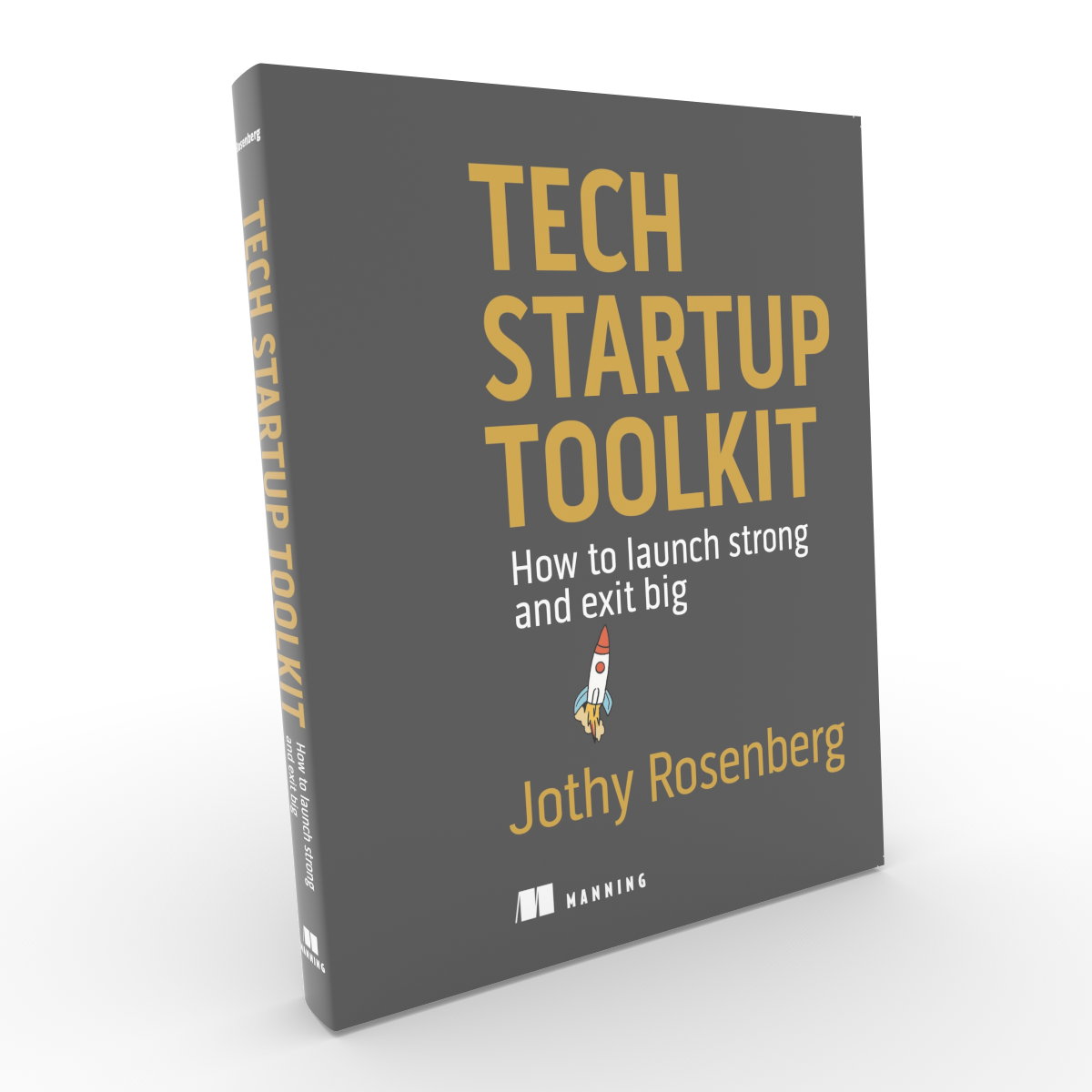
Buy the Full Founder Journey Bundle
AND
Get the signed book Tech Startup Toolkit!
*Introductory price: $689